Is Spirituality the New Therapy? Inside India’s Booming Wellness Economy
As urban Indians increasingly blend ancient practice with modern self-care, a Bangalore couple is quietly leading the charge
In Mumbai’s corporate corridors and Bangalore’s startup enclaves, something subtle but significant is shifting. The generation that grew up scheduling therapy appointments and tracking sleep cycles on smartwatches is now also booking tarot readings, attending pranic healing sessions, and openly discussing concepts like energy blocks and karmic cycles ,without apology and without embarrassment.
Spirituality, it seems, is no longer the domain of temple priests and grandmother’s rituals. It has migrated into the vocabulary of the upwardly mobile, the analytically minded, and the emotionally exhausted. And a growing number of certified practitioners, entrepreneurs, and digital creators are meeting them exactly where they are.
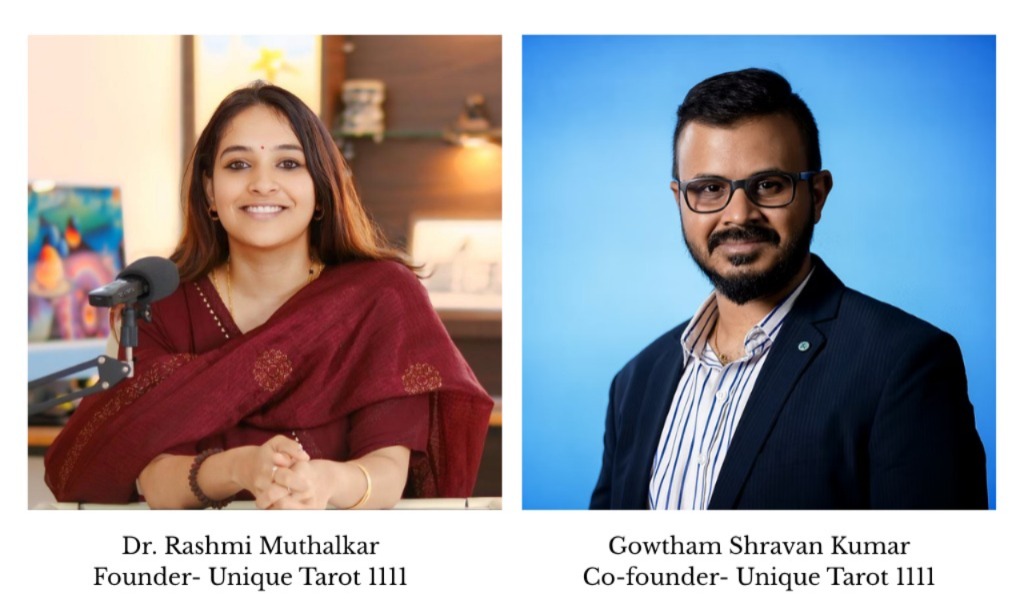
Among them is Dr. Rashmi Muthalkar, founder of UniqueTarot1111, and her husband Gowtham Shravan Kumar, the platform’s co-founder and creative director. Based in Bangalore but with a following that stretches well beyond city limits, the couple represents something increasingly visible in India’s wellness landscape: spiritual practice that is structured, accessible, and unapologetically modern.
A Market That Can No Longer Be Ignored
The numbers tell a story that boardrooms are beginning to take seriously. India’s wellness economy has been expanding at a pace that few anticipated even five years ago. From mindfulness apps to sound bath studios, from astrology newsletters to certified energy healers, the appetite for non-clinical tools of self-understanding has grown steadily among millennials and Gen Z consumers in particular.
What has changed is not just the demand but the demographic. Today’s spiritual seeker is just as likely to hold an MBA as a mala bead. They are founders navigating funding anxiety, middle managers quietly unravelling under performance pressure, and young professionals in their twenties grappling with questions that quarterly reviews simply cannot answer: Why do I feel stuck? Why do the same patterns keep repeating? What am I actually working toward?
It is precisely this audience that platforms like UniqueTarot1111 have built their communities around. “A large part of our audience comes from high pressure corporate environments, especially in cities like Bangalore,” says Gowtham. “The most common patterns we see are burnout, lack of clarity, emotional exhaustion, and a disconnect from purpose.”
When Science Leaves a Gap
To understand why spiritual tools are gaining traction alongside conventional therapy and medicine, it helps to listen to the practitioners themselves ,particularly those who, like Dr. Rashmi, come from scientific backgrounds.
Dr. Rashmi trained and worked as a dentist before making a significant career pivot into full-time spiritual practice. She is certified in pranic healing, psychological counselling, and tarot reading. Her entry into this field was not a retreat from rational thinking. It was, in many ways, an extension of it.
“We always emphasise that these healings and readings are meant to be a form of support, not a replacement for science or practical action,” she says. “Sometimes, when science cannot provide all the answers, our work helps individuals process their experiences. We do not claim to fix lives. We help people build acceptance, shift internally, and gain clarity so they can navigate life more effectively.”
This framing matters. One of the consistent criticisms levelled at spiritual wellness is that it encourages magical thinking at the expense of practical responsibility. What practitioners like Dr. Rashmi are articulating is something more nuanced: that there is a layer of human experience, grief, confusion, pattern recognition, emotional stuck-ness, that clinical frameworks do not always fully address. And that tools like tarot or energy healing can serve as mirrors, not magic wands.
“We present concepts like Akashic Records or energy healing not as something abstract or mystical alone, but as tools for self awareness and reflection,” adds Gowtham. “We do not position this work as a replacement for practical action. We position it as a layer of insight that helps people process their experiences, make sense of patterns, and move forward with more clarity.”
The Gen Z and Millennial Effect
Perhaps no generation has done more to normalise the intersection of mental health and spirituality than the one that grew up on Instagram and came of age during a global pandemic. The same cohort that flooded therapists’ waitlists in 2020 also drove a significant spike in interest around astrology, manifestation, and energy practices.
There is an important reason for this, beyond mere trend-chasing. Younger Indians, particularly those in metropolitan cities, are confronting a peculiar kind of identity pressure: they are expected to be globally competitive and locally rooted, rationally driven and emotionally intelligent, high-achieving and mentally healthy. Traditional religious frameworks often feel too rigid. Pure clinical therapy can feel too detached. Spiritual wellness, at its best, offers something in between: a personalised, reflective, and often deeply compassionate space to examine one’s own life.
Social media has accelerated this mainstreaming considerably. YouTube channels, Instagram reels, and live sessions have brought practices that once lived behind closed doors into the daily scroll of millions of Indians. Creators who can communicate spiritual concepts in plain, relatable language have found audiences that grow faster than almost any other content category.
UniqueTarot1111 has built its digital presence on exactly this principle. Gowtham, whose background is in content creation, media, and digital storytelling, has been deliberate about how the platform presents its work. The language is grounded. The tone is warm but not breathless. The claims are careful. “I naturally tend to look at things from a logical and structured perspective,” he says, “which helps us bridge the gap between spirituality and mainstream understanding.”
Credibility in a Crowded Space
As with any booming market, the spiritual wellness space in India is not without its complications. The rapid growth of the sector has also brought with it a wave of unverified practitioners, exaggerated claims, and, at the more troubling end, outright exploitation of vulnerable people seeking guidance during difficult moments in their lives.
This is precisely why credentialing, transparency, and ethical positioning matter more than ever in this field. Practitioners who come with verified certifications, clear communication about what their work can and cannot do, and a demonstrated commitment to their clients’ autonomy are increasingly distinguishing themselves from those who promise transformation without foundation.
Dr. Rashmi’s formal certifications in pranic healing and psychological counselling, combined with her medical background, give her practice a level of accountability that many in the space lack. “We do not claim to fix lives,” she is careful to say. It is a small sentence, but in an industry where overclaiming is common, it carries weight.
The couple’s approach of providing independent readings that consistently align with each other has also become a quiet trust-builder with their clientele. On one notable occasion, a client separately asked both Dr. Rashmi and Gowtham the same question about a relationship, during completely unconnected sessions. Both gave the same answer. “That alignment often becomes a turning point for clients,” says Gowtham, “because it builds trust in the process.”
What Comes Next
If the current trajectory holds, the integration of spiritual practice into mainstream Indian wellness is not a passing moment. It is a structural shift, one driven by demographic reality, digital access, and a growing cultural willingness to talk about emotional and psychological wellbeing in ways that previous generations simply did not.
Platforms that can hold both rigour and openness, both ancient wisdom and modern sensibility, are the ones likely to endure. For UniqueTarot1111, the ambition is clear. “Our vision is to reach and support more people globally,” says Dr. Rashmi. “We aim to make our work more accessible while continuing to spread kindness, awareness, and emotional healing at a larger scale.”
For a generation rewriting the rules of what it means to take care of oneself, that might be exactly the kind of guidance they are looking for.
Atul Tiwari is a seasoned journalist at Mumbai Times, specializing in city news, culture, and human-interest stories. With a knack for uncovering compelling narratives, Atul brings Mumbai’s vibrant spirit to life through his writing.