A Mahā-bhārata That Begins Before the War: New Book Opens With a Fisherman’s Daughter and an Invasion of Earth
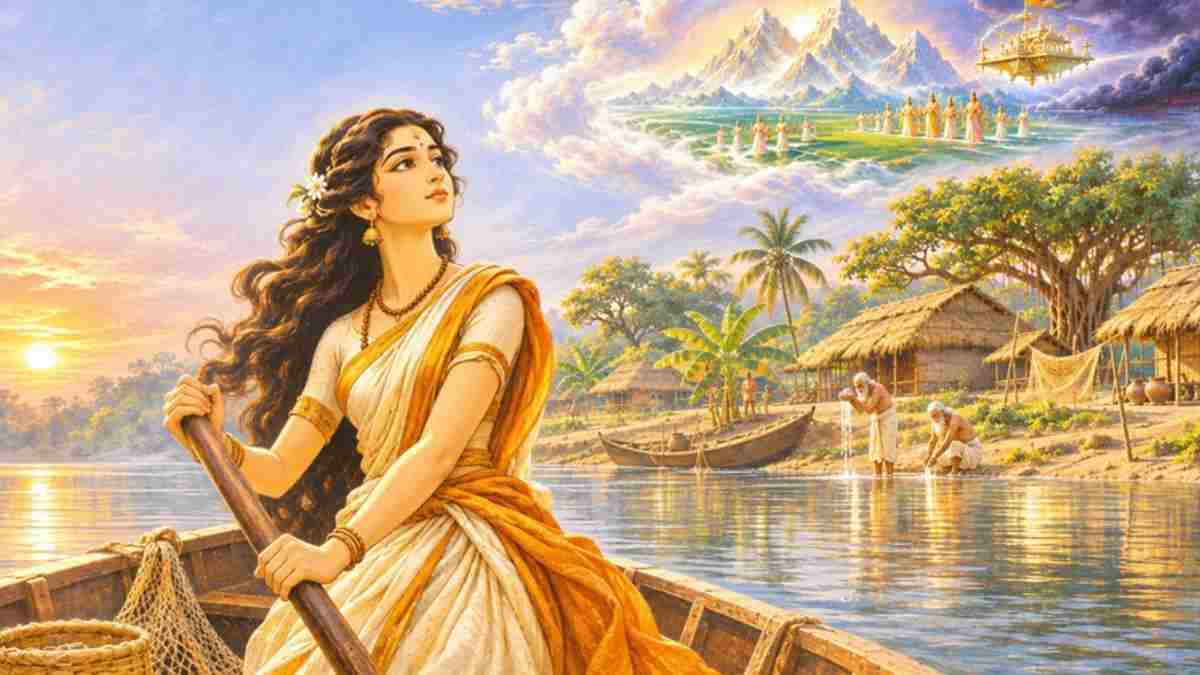
Great Bhārata: The Invasion Begins starts four generations before the Pāṇḍavas and Kurus appear, on the bank of the Yamunā River, with a young woman who ferries sages across the water.
Most retellings of the Mahā-bhārata open with the rivalry of two royal families. Great Bhārata: The Invasion Begins, Volume One of Howard Resnick’s reconstruction of the epic, opens in a fishing village named Kalpi. Its heroine is Satya-vatī, the fisher chief’s daughter, who spends her days rowing sages across the river and refuses to be called a fisher princess.
The starting point is a deliberate choice. The Mahā-bhārata itself notes that some sages begin the story with King Vasu of Cedi, who lived four generations before the central characters. Resnick, who holds a PhD, follows that option because, in his view, the famous events cannot be understood without the world that produced them.
The story turns when the young sage Parā-śara takes Satya-vatī, through meditation, to the celestial realm. She watches a clash between Devas and Asuras on the shore of the Milk Sea, a clash whose outcome would decide the fate of the three worlds. Then she learns something closer to home. The fisher couple who raised her are not her birth parents. She is the daughter of King Vasu and Queen Girikā of Cedi, and she has a part to play in bringing an Avatāra into a world under threat.
What the book leaves out
Reprensted by Saisha Nighhot’s Avion Marketing, The Mahā-bhārata is one of the largest books ever composed. Resnick’s introduction notes that it is three times the size of the Old and New Testament combined and seven times the size of the Iliad and Odyssey together. He also points out that the central plot is only about a fifth of the whole, a figure he supports with the Britannica’s description of the epic. The rest is made up of secondary stories.
Resnick leaves those stories out. The epic itself mentions a shorter version with a quarter of the verses and none of the side tales, and he argues that the extra material slows the main narrative. The result is a single story told in 31 chapters, with the momentum of a novel.
The invasion at the center
The subtitle names what Resnick sees as the epic’s lost spine: an invasion of Earth and the struggle to save it. He calls the habit of forgetting this theme “narrative amnesia” and links it to Kṛṣṇa’s words in the Bhagavad-gītā, where he says he appears whenever justice fails. The Bhāgavatam, Resnick notes, criticizes the Mahā-bhārata for shrinking a cosmic story into purely human proportions.
He also expects the theme to feel familiar. Battles between Earth and outsiders disguised as earthlings are, he observes, among Hollywood’s most popular genres, which suggests the idea speaks to something deep in readers whether they take it as history or as storytelling.
How it was built
Resnick worked from the critical Sanskrit text of the Mahā-bhārata, the Purāṇic Encyclopedia of Vettam Mani, and the Bhāgavatam. He writes that he has spent fifty-three years in the bhakti-yoga tradition and has translated hundreds of chapters of both the Mahā-bhārata and the Bhāgavatam from Sanskrit. He says openly that his approach is both critical and devotional, and that the book does not ask readers to share any particular worldview.
The volume closes on a held breath. Satya-vatī, traveling toward the Kuru capital Hastinā-pura with Prince Deva-vrata, sees a cavalry unit in Kuru colors thundering toward her party. Her fate, and perhaps the world’s, depends on the message they carry.
About the book
Great Bhārata: The Invasion Begins, Volume One by Howard Resnick, PhD. HDG Global Publications, Second Edition. ISBN 979-8-9959146-5-5. Cover illustration by Onkar Fondekar. The volume includes a full Introduction, 31 chapters, and a set of historical maps of the Mahā-bhārata world.

Atul Tiwari is a seasoned journalist at Mumbai Times, specializing in city news, culture, and human-interest stories. With a knack for uncovering compelling narratives, Atul brings Mumbai’s vibrant spirit to life through his writing.